
Money Hiding in Plain Sight:
Employer-Provided Child Care Tax Credit
The Employer-Provided Child Care Tax Credit, outlined under Section 45F of the Internal Revenue Code and claimed using IRS Form 8882, is sometimes referred to as the Section 45F Credit.
This credit offers employers a strategic advantage- reducing tax liability while addressing a key workforce need. It’s a powerful tool that can help businesses work toward improving employee retention, productivity, and satisfaction—essential for businesses competing in today’s talent-driven economy.
Calculate your potential credit with our Employer-Provided Childcare Credit Calculator.
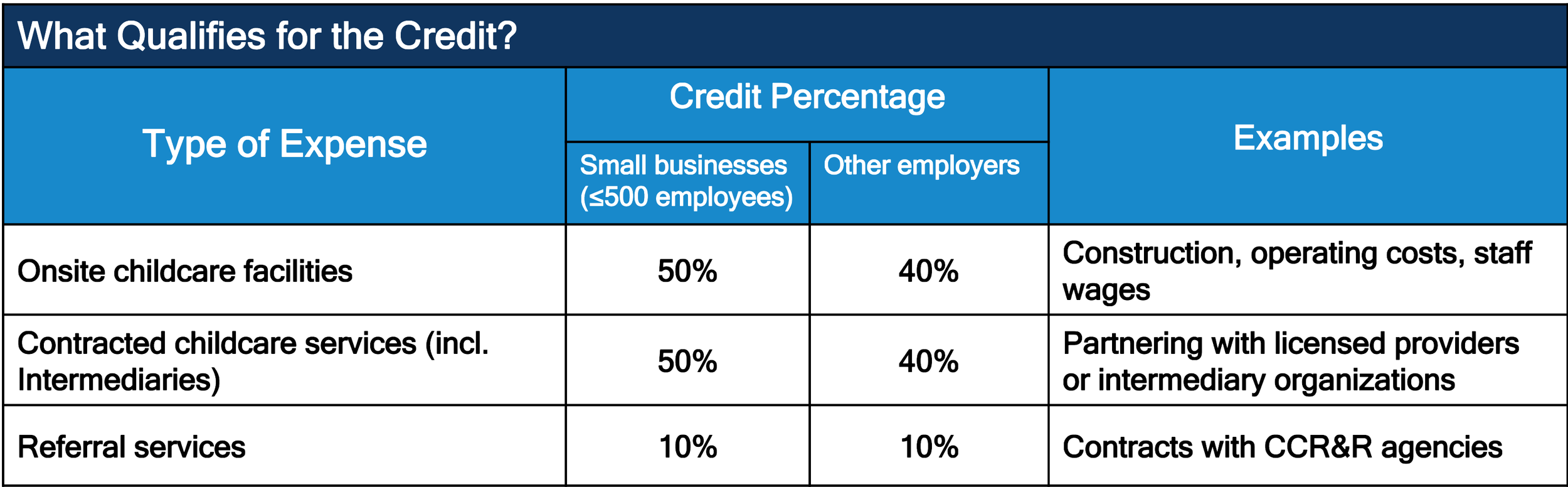
For more than 20 years, this federal tax incentive has helped businesses offset the cost of supporting employees’ child care. Starting in 2026, employers can claim a federal income tax credit for 40% of qualified child care expenses (or 50% for small business with 500 or fewer employees), plus 10% of qualified child care resource and referral costs, with a maximum annual credit of $500,000 for most employers and $600,000 for small businesses.
Why This Credit Matters to Your Business
Tax Savings: Claim 40% of qualified child care expenses (or 50% for small businessed with 500 or fewer employees) and 10% of referral services costs, with a maximum credit of $500,000 per year for most employers and $600,000 for small businesses.
Better Recruitment and Retention: Child care support is a highly sought-after benefit, helping you attract and retain top talent by addressing a critical workforce need.
Increased Productivity: Reliable, quality child care allows employees to focus on their work, improving efficiency and morale while reducing absenteeism.
Enhanced Reputation: Offering child care benefits demonstrates your commitment to employees' well-being, positioning your business as an employer of choice.
For Employees:
Lower Costs: Employer-provided child care reduces families' out-of-pocket expenses.
Work-Life Balance: Reliable care helps employees successfully integrate the responsibilities of both their professional and personal lives.
Access to Tax Benefits: Employees can combine these benefits with FSAs or the Child and Dependent Care Tax Credit for greater savings.
Common Myths About the Employer-Provided Child Care Tax Credit
Myth: It’s only for onsite child care.
Reality: While onsite child care qualifies, the credit also covers expenses for contracting with licensed offsite provider and intermediary organizations that arrange care with one or more qualified child care facilities. This means that employers can partner with third-party child care organizations to provide services for employees, and those contracted expenses are eligible.
Myth: Only large companies can benefit.
Reality: This credit is accessible to businesses of all sizes, including small education and child care providers. Small and mid-sized businesses can offer subsidies, partner with child care providers, or provide referral services, and now receive a credit worth up to 40-50% of their eligible costs, with higher annual limits for small employers. This means even modest investments can make a big difference for employers.
Myth: The credit isn’t worth it.
Reality: With a maximum annual credit of $500,000 for most employers and up to $600,000 for eligible small businesses, the potential savings can make employer-provided care a reality for many businesses. Supporting child care also boosts employee satisfaction, retention, and productivity - which helps both the employer and the employee.
Myth: The form is hard to fill out.
Reality: IRS Form 8882 is straightforward, requiring only basic details about qualified expenses. Even with the expanded credit, if your tax preparer is not familiar with filling out the form, the IRS provides clear instructions, making it simple and easy for businesses to complete on their own.
How Can Employers Qualify?
Onsite Care for Employees: Expenses for constructing, operating, or expanding a child care facility for employees.
Contracting with Child Care Providers or Intermediaries: Costs for partnering with offsite licensed providers or intermediary organizations that contract with one or more qualified child care facilities to offer care for employees’ children.
Referral Services: Costs of contracting with child care resource and referral agencies to help employees find care.
Key Rules:
Open Access: The benefit must be available to all employees and cannot favor highly compensated employees.
Child Care Businesses: If you run a child care business, at least 30% of enrolled children must be employees’ dependents for you to qualify for the credit.
Examples of Tax Savings
Example 1: Gidgets & Gizmos Corporation
Gidgets & Gizmos has more than 500 employees, so it uses the standard 40% credit rate for child care expenses
Child Care Contract: $50,000 with Happy Apple Child Care (40% credit = $20,000)
Referral Services: $10,000 with a local CCR&R agency (10% credit = $1,000)
Total Tax Credit: $21,000
Example 2: Goodman LLC
Goodman LLC is a small business with 500 or fewer employees, so it can use the higher 50% credit rate for child care expenses.
Onsite Facility Costs: Includes construction, staff wages, and operational expenses for a facility managed by Little Learners.
Construction Costs: $200,000 for building and outfitting the facility (eligible expense = $200,000)
Staff Salaries: $120,000 for child care employees (eligible expense = $120,000)
Annual Operational Costs: $80,000 for supplies, utilities, and maintenance (eligible expense = $80,000)
Total Eligible Expenses: $400,000
Tax Credit Calculation: $400,000 × 50% = $200,000
Total Tax Credit: $200,000
How to Claim the Credit in 3 Simple Steps
Track Qualified Expenses: Gather details on costs for child care facilities, contracts with providers, and referral services.
Complete IRS Form 8882: This form requires basic details about qualified expenses and credit calculations. Tax professionals or in-house teams can easily handle it.
Include in Your Tax Filing: Report the credit as part of the general business credit when filing your business taxes.
Calculate your credit using our Employer-Provided Childcare Credit Calculator
FAQs: Clearing Up Common Questions
Can both large and small businesses take advantage of this credit?
Absolutely. This credit is designed to be accessible to businesses of all sizes. Small and mid-sized businesses, in particular, can benefit by partnering with child care providers or offering subsidies, and now receive a credit worth up to 50% of eligible costs with a maximum of $600,000 per year. Larger employers can receive 40% of eligible costs with a maximum credit of $500,000 per year.
Can non-profit organizations claim this credit?
No, the Employer-Provided Child Care Tax Credit is only available to for-profit businesses.
What documentation is needed?
Maintain records of all qualified child care expenses, including invoices, contracts, and payroll related to the child care program.
Can a business claim the credit if it contracts with multiple child care providers?
Yes. You can claim the credit for expenses incurred with multiple licensed child care providers and with intermediary organizations that contract with one or more qualified providers, as long as the expenses meet the eligibility requirements. Each contract must be for qualified child care services or referral services for your employees.
Is there a limit to how much a business can spend on child care to claim the credit?
While there’s no limit to how much you can spend on child care, the maximum tax credit you can claim is now $500,000 per year for most employers and $600,000 per year for small businesses with 500 or fewer employees.
What happens if my expenses exceed the credit limit?
The credit is capped at $500,000 per year for most employers and $600,000 per year for small businesses, so any expenses beyond that amount won’t qualify for additional credit but may still be deductible as business expenses.
Are child care expenses fully deductible if I claim the credit?
No, you can only deduct the portion of expenses not covered by the credit. For example, if you claim a 40% credit for child care costs, the remaining 60% may still be deductible as a business expense.
For more information, visit the IRS website and search for Form 8882 or consult your tax advisor.
Have questions? You can reach out to us on info@civstrat.com